Key takeaways
- For the documented Bitcoin weekly above-strike contract, Yes wins strictly above the strike; No wins at or below it.
- Each winning share ordinarily pays $1. The gain depends on what you paid and the costs.
- If insufficient data causes a void, both sides settle at $0.50 per share, which can be above or below your purchase price.
Specify the view before looking at the quote
Write down the asset, strike, expiry and condition. In this hypothetical example the question is: “Will Bitcoin's settlement price be above $80,000 at expiry?” The $80,000 strike and the purchase prices below are illustrative, not a claim that this exact contract or quote is currently available.
Buying Yes expresses strictly above. Buying No expresses not above, including equality, under the documented weekly rule. The payout is fixed per share once the outcome is resolved; a much higher Bitcoin price does not increase a winning share's $1 payout.
From a Bitcoin view to an order draft in Skew
This walkthrough was captured in Skew's mainnet app on October 27, 2026. It follows the listed BTC contract for October 30 at 08:00 UTC, with an $81,000 strike. These are dated product screenshots, not a live quote or an executed trade. The market and prices shown may no longer be available.
1Choose Bitcoin and the expiry
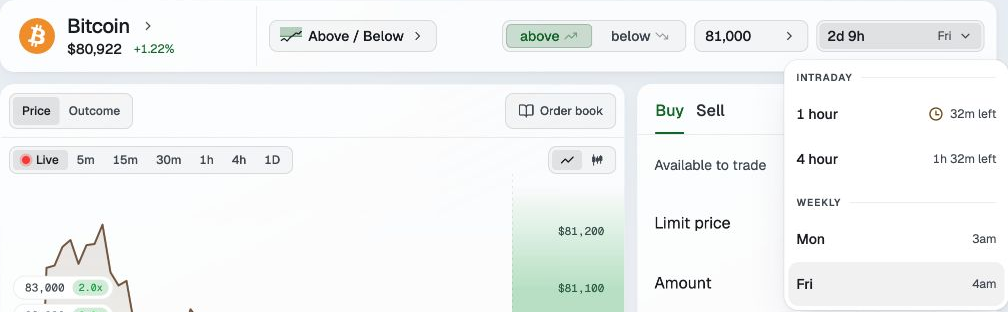
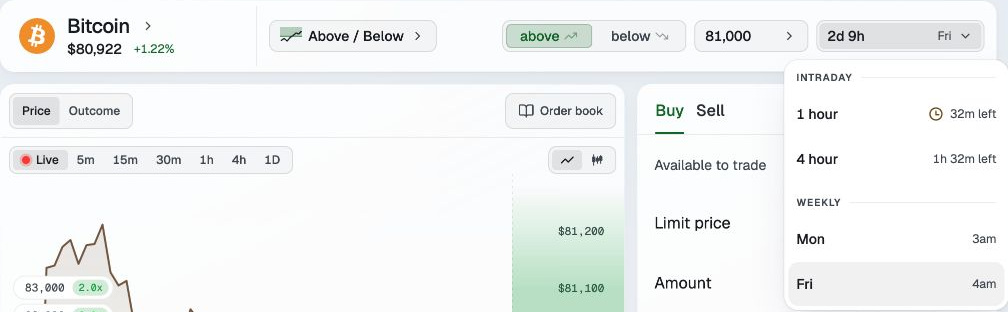
Start with the view: “Bitcoin's settlement price will be above $81,000 on October 30 at 08:00 UTC.” In Bitcoin's Above / Below market, select the Friday expiry. The app displays local time: 4am Eastern Daylight Time in this capture is 08:00 UTC. Check the full date and timezone in the selected contract's resolution terms.
 View full-size screenshot
Mainnet capture · October 27, 2026. The selected Friday contract expires October 30 at 08:00 UTC; the menu shows the viewer's local time. 2Select the $81,000 level and Above
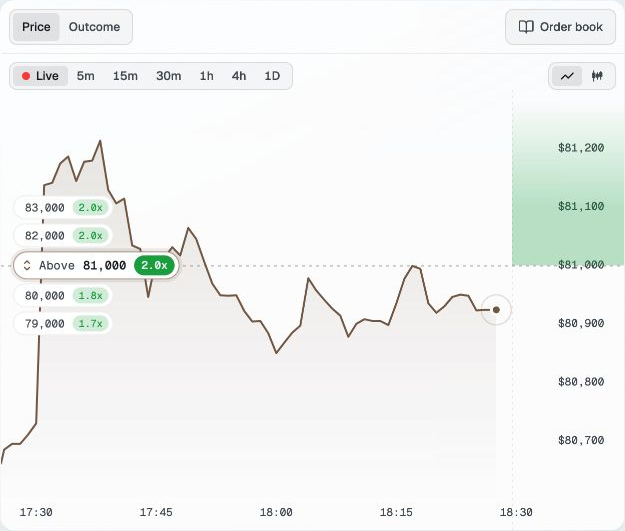
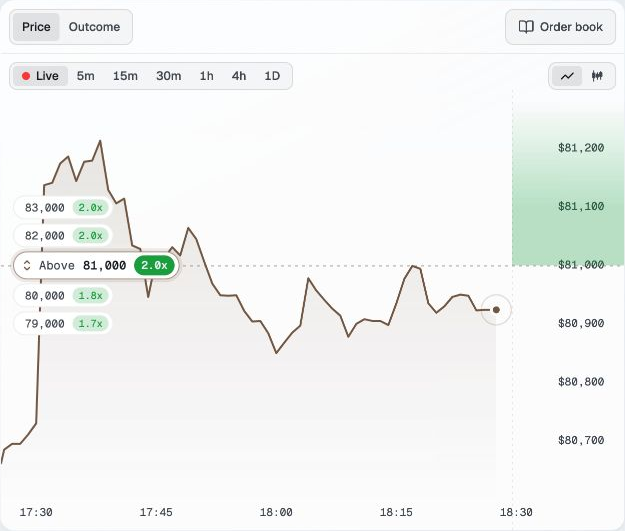
Select the listed $81,000 level with Above selected. This contract resolves to Yes if the computed BTC price is strictly above $81,000, and to No otherwise. Its displayed terms use the 90-second TWAP of Pyth BTC/USD ending at expiry. The moving chart price is not the final settlement calculation.
 View full-size screenshot
The selected strike defines the condition. An earlier move above the line does not decide an expiry-only outcome. 3Read the order draft as cost and total payout
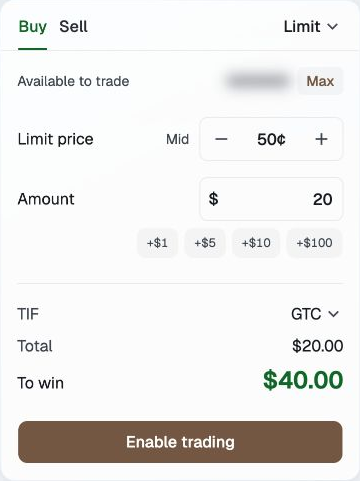
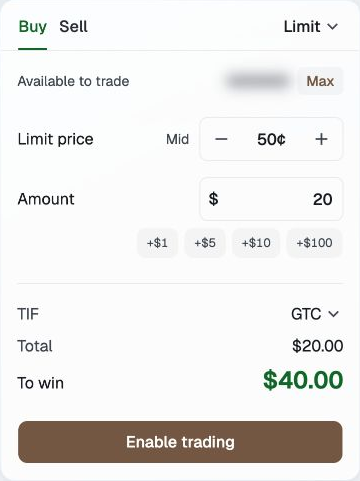
In Buy, choose Limit. For this capture we used the Mid control, which filled a 50¢ limit price, and entered a $20 amount. The draft shows Total $20.00 and To win $40.00. This is a proposed limit order; it does not establish that the order would fill at that price.
If fully filled at 50¢ per share, $20 buys 40 shares. An ordinary winning settlement would pay $40 in total, giving a $20 gain before fees. A losing settlement would pay $0, giving a $20 loss before fees. “To win” is the total winning payout here, not $40 of profit. Closing or settlement fees reduce the net result.
 View full-size screenshot
Illustrative order draft in the actual mainnet app. No trading was enabled and no order was submitted. Account balances are hidden.
A worked payout example
Compare two alternative purchases: 100 Yes shares at $0.40 each, costing $40, or 100 No shares at $0.60 each, costing $60. Each column describes a separate position, not a recommendation to buy both. All amounts below exclude fees and other execution costs.
| Final resolution | Yes: $40 purchase cost | No: $60 purchase cost |
|---|---|---|
| Computed price $80,100: above | $100 payout; +$60 net | $0 payout; −$60 net |
| Computed price $80,000: exactly equal | $0 payout; −$40 net | $100 payout; +$40 net |
| Computed price $79,900: below | $0 payout; −$40 net | $100 payout; +$40 net |
| Void under the insufficient-data rule | $50 payout; +$10 net | $50 payout; −$10 net |
Net result = settlement payout − purchase cost, before fees. A void is not a purchase-price refund. Your actual net result must also account for applicable fees and execution costs.
An earlier touch does not settle an expiry condition
Suppose Bitcoin trades above $80,000 during the week but the contract's computed settlement price is $79,900. The Yes side of this above-$80,000 example still loses. Conversely, a brief move below the level earlier does not decide the final result.
Skew's Bitcoin weekly documentation, checked on October 28, 2026, lists Monday and Friday expiries at 08:00 UTC throughout the year. The contract captured above lists October 30 at that time. Use the exact expiry in the selected contract's terms. The weekly price is a confidence-weighted time average of Pyth data over the final 90 seconds ending at expiry. A single last trade is not that average. Other Skew market families use different sources or calculations.
When this expression fits — and when it does not
The expression can match a view about a specified final price condition if a suitable listed strike and expiry exist. It also makes the ordinary winning payout and the purchase cost explicit before a fully paid purchase.
It does not give you Bitcoin ownership, unlimited participation in a rally, or a touch-before-expiry payoff. A planned early sale adds price and execution uncertainty. If your view is instead about the magnitude of a move or holding an asset indefinitely, compare other instruments' mechanics.
Sources & method
The walkthrough records the actual mainnet app and BTC market 16088 on October 27, 2026, with the environment and current 08:00 UTC weekly expiry confirmed by Skew's product team. Screenshots are cropped to omit account identity, with privacy mode hiding balances; market values have not been altered. We selected a contract and entered a limit-order draft, stopping before enabling trading or submitting an order. The draft's share count and before-fee result are derived arithmetic, not fills. The separate 100-share table uses hypothetical purchases and the documented $1/$0 ordinary payout and $0.50 void payout. Neither example is trading performance, a live quote or a probability estimate.
Examples explain mechanics, not expected returns. Trading can result in loss. Read the trading risks.
Check the actual market.
Review the available strikes, expiries and contract rules in Skew. Access depends on eligibility and location.
Open Skew